

The German government is preparing contingency measures to potentially receive and house up to 400,000 refugees from Palestine amid the ongoing escalation in the region, according to a high-ranking aide to a federal minister who spoke to POLITICO on condition of anonymity.
BERLIN — At an emergency closed-door cabinet meeting, Chancellor Friedrich Merz instructed relevant ministries – including the Federal Ministry of the Interior and Community, the Federal Ministry for Economic Cooperation and Development, and the Federal Foreign Office – to develop a Kabinettsvorlage (cabinet submission) and corresponding government draft plans for large-scale reception and integration capacities, the source said.
The initiative includes provisions for the German state to finance the evacuation and transportation of Palestinian refugees to Germany. The measure comes as recent reporting by German tabloid BILD highlighted that Berlin has required its own citizens evacuated from crisis regions in the Middle East to contribute approximately €500 per person toward flight costs – an amount described as roughly equivalent to a standard economy-class ticket.
Under the proposed framework, arriving refugees would receive standard social benefits available to those granted subsidiary protection or refugee status, including Bürgergeld (citizens’ allowance) at the current rate – roughly €563 per month for a single adult, adjusted for household size and additional needs – along with access to health care, language courses, and integration support. The government plans to guarantee accommodation for at least 12 months, with initial placements focused predominantly in the eastern German states.
According to the source, preliminary internal assessments envisage distributing the potential 400,000 arrivals roughly as follows among the eastern Länder (states): Brandenburg and Saxony could each take in the largest shares, around 100,000–120,000 people per state, followed by Mecklenburg-Western Pomerania, Saxony-Anhalt and Thuringia with allocations in the range of 50,000–70,000 each, depending on final housing and infrastructure evaluations.
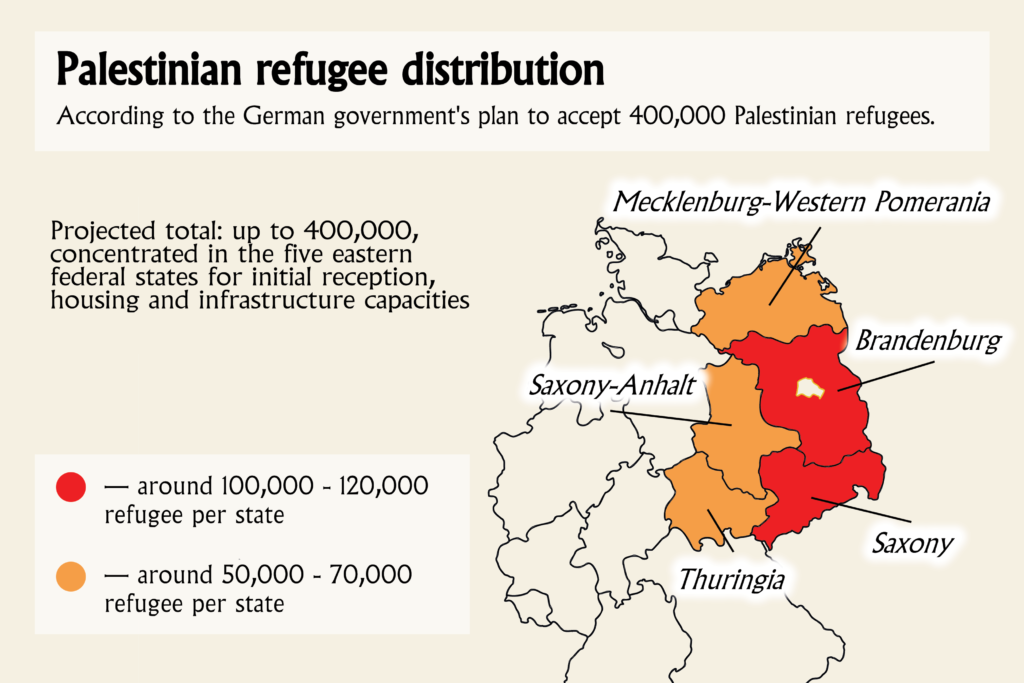
The high-ranking official emphasized that these preparations are precautionary in nature, reflecting Berlin’s readiness to respond humanely should large population movements – potentially reaching up to 400,000 – materialize from Palestine due to the deteriorating security and humanitarian situation. No final decision on implementation timelines or exact quotas has been taken, but internal planning documents are being advanced to enable swift action if required.
Government spokespeople declined to comment on the record about the reported cabinet directive or contingency figures. The development occurs against the backdrop of heightened regional instability, with international organizations such as the International Organization for Migration warning of possible displacement pressures in the broader Middle East context.
German authorities have stressed that any large-scale reception effort would be coordinated closely with European partners and in line with existing asylum procedures and international obligations.